We place strong emphasis on public outreach as an integral part of our research activities. Here we introduce selected outreach efforts through research videos, magazine articles, public events, and interviews. Please note that most of the linked content is currently only available in Japanese, with the exception of Maria Arima and Yuka Kaneda, whose information is accessible in English.
Collisions between galactic disk gas and dwarf galaxies are important processes in galaxy formation and evolution. Such collisions are known to strongly affect the distribution and kinematics of gas in galaxies, triggering changes in star formation activity and galactic structure. In this study, we use numerical simulations to investigate in detail the collision process between galactic disk gas and dwarf galaxies, and to clarify the resulting gas dynamics and changes in star formation activity.
Supermassive black holes, which are thought to reside in almost all galaxies, are widely known
through active galactic nuclei (AGN), where they accrete matter and release enormous amounts of
energy. At the same time, observations suggest that many of them are currently almost inactive,
in a so-called dormant state.
Galaxy collisions, meanwhile, are key events in galaxy formation and evolution, and are also
known to have a major impact on the activity of central supermassive black holes.
Previous studies have suggested that galaxy collisions may enhance black hole growth and
activity; this study, in contrast, shows that such collisions may also suppress black hole
activity.
Galactic outflows, or gas flows expelled from galaxies, play an important role in galaxy formation and evolution. In particular, galaxies in the early Universe are thought to generate powerful outflows driven by intense star formation, expelling gas from galaxies and thereby suppressing subsequent star formation. In this study, we investigate the properties and impact of galactic outflows from galaxies in the early Universe using analytical methods rather than simulations. By quantitatively evaluating how galactic outflows are launched and how much mass and energy they carry away, we aim to clarify how they influence galaxy evolution and the surrounding environment.
The cold dark matter hypothesis predicts the existence of numerous dark matter subhaloes. However, many of them have not yet been observed directly. This study focuses on fine structures imprinted in stellar streams as a way to search for traces of otherwise invisible dark matter. By analysing gaps and distortions produced when a subhalo passes through a stellar stream, we present a new method for probing the distribution and nature of dark matter.
Around the Andromeda Galaxy, one finds giant stellar streams and shell-like structures that are thought to be the remnants of past galaxy collisions. In this study, we investigate what kind of collision produced these structures and how dark matter was involved in the process. In particular, we focus on how the mass distribution of the dark matter halo associated with the accreted satellite galaxy determines the shape and spatial distribution of the resulting streams.
In the M81 Group, located about 12 million light-years away in the direction of Ursa Major, complex gas and stellar structures extending far into the outskirts of galaxies have been formed through gravitational interactions among galaxies. This study addresses whether the young star clusters and candidate dwarf galaxies found in this environment were stripped from existing galaxies or newly formed in intergalactic space. By combining observations and theory to examine the conditions for star formation in tidally stretched gas, we aim to clarify the possibility of star formation outside galaxies and the physical processes behind it.
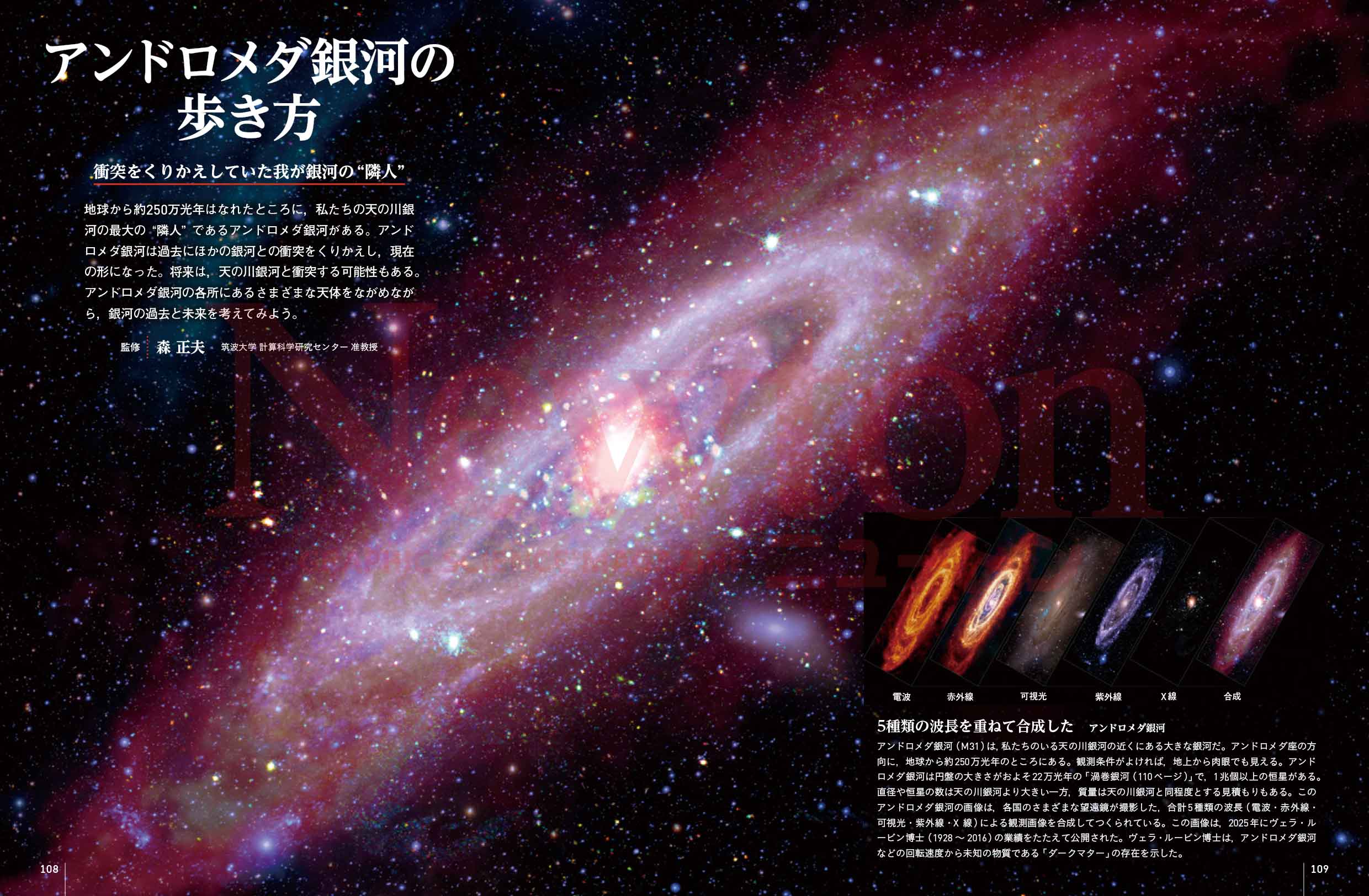
I served as scientific supervisor for the feature article “A Guide to the Andromeda Galaxy”
published in the May 2026 issue of Newton magazine (released on March 26, 2026).
The Andromeda Galaxy is the nearest giant galaxy to us.
Within it are imprinted many mysteries and layers of cosmic structure,
including dark-matter-dominated components, black-hole activity, and the remnants of galaxy
collisions.
Based on the latest observations and theoretical studies, this feature article presents a broad
and accessible overview of the structure and evolution of the Andromeda Galaxy from multiple
perspectives.
On August 18, 2025, Misa Yamaguchi (then a PhD student, 1st year) gave a research presentation at the Science Expo, “Connecting Myself and the Future,” held at Expo 2025 Osaka, Kansai. Her presentation focused on past galaxy collisions in Andromeda and the origin of the giant stream and halo structures formed as their remnants. Through numerical simulations, she demonstrated how such complex observed structures can arise from specific initial conditions and visualized the dynamics of galaxy evolution.
This section corresponds to the Activities post dated August 18, 2025. The relevant segment begins at approximately 5:44:13.
This is an interview with Yuka Kaneda (then an MSc student, 2nd year) during her participation in IAU Symposium 379. She discusses the so-called cusp-core problem, namely the discrepancy between the cored inner profiles inferred from observations of nearby dwarf galaxies and the cuspy profiles predicted by the cold dark matter model. This problem is important not only for understanding the nature of dark matter itself but also for clarifying how baryonic physics affects halo structure.
This section corresponds to the Activities post dated July 2, 2024. The relevant segment is approximately 8:35–10:14.