Small Scale Problems in the Cold Dark Matter Framework
In 1933, Dr. Fritz Zwicky inferred the presence of “unseen mass” from the motions of galaxies within the Coma Cluster. This unknown component was later named dark matter (DM), and its true nature remains one of the greatest mysteries in modern science. Cold Dark Matter (CDM) is considered the leading candidate, and the hierarchical structure formation model—based on CDM and characterized by a bottom-up scenario in which small-scale structures form first and subsequently merge to create larger ones—agrees well with several observational facts. These include the presence of very old galaxies and the comparatively recent formation of large-scale structures such as galaxy clusters.
On the other hand, by the 1990s, several discrepancies between CDM-based predictions and observations on small scales—such as those of galaxies and dwarf galaxies—had been pointed out.
To investigate how such discrepancies arise in more detail, we use N-body simulations to study the formation and evolution of dwarf galaxies, in which dark matter accounts for the vast majority of the total mass.
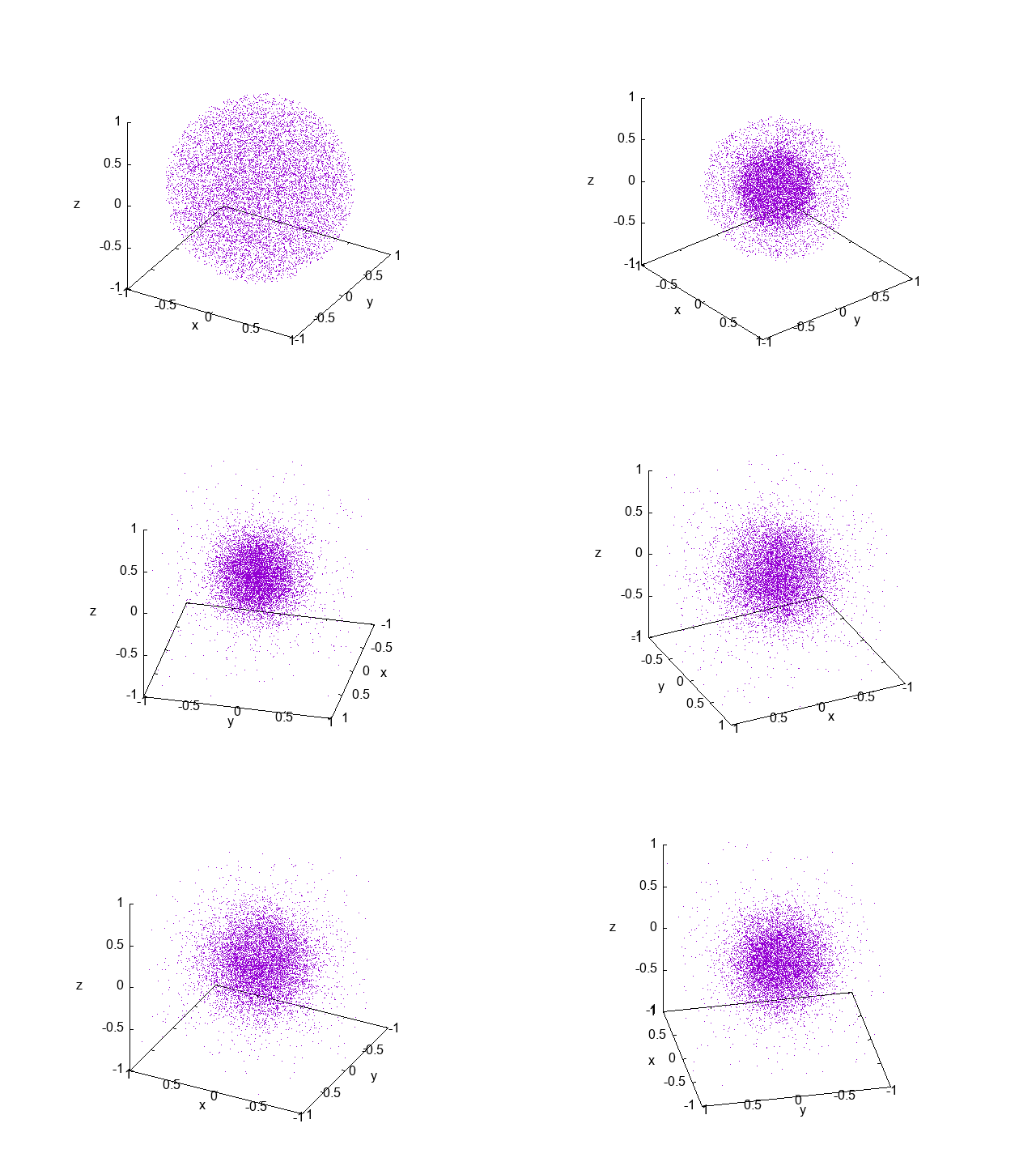
A simulation that numerically computes the gravitational interactions among N particles is called an N-body simulation. For example, if we assign one quarter of the total potential energy as kinetic energy to a system of 10,000 particles and evolve it for ten free-fall times, the result can be visualized as follows.